Thursday, November 15, 2012
Local Councils and Resource Allocation
Wednesday, April 8, 2009
Wipe out illegal advertising and "poster politicians"
It's about time that serious action is taken on illegal advertising. They are an annoying eyesore that seriously make Malaysian urban centres, not just KL, look like slums.
I have always wondered why the local council enforcement people don't just look up the contact numbers and, once the facts are clear, just whack them with a hefty fine for creating the mess.
So, this is timely news:
KUALA Lumpur mayor Datuk Ahmad Fuad Ismail feels that enough is enough and has decided to launch a war against the widespread illegal advertisement nuisance in the federal capital.
Fuad said he would go all out to catch the perpetrators of the abuse by calling up the contact numbers on the illegal advertisements and then book them for vandalism.
He said that the only way to stop the mushrooming of illegal advertisement posters, banners and buntings put up by the ah longs (loan sharks), tuition centres and those offering various services, was to go after the persons sponsoring them.
“Removing the adverts and stickers is no longer a viable solution as the perpetrators keep coming back. Drastic action must be taken to teach the culprits a lesson,” Fuad said.
He said that the Kuala Lumpur City Hall (DBKL) enforcement team would be instructed to call up the number directly and find out where they were operating from.
Read the rest of the report here.
I am also very amused by the curling and piercing remarks in Zainul Ariffin's op-ed column where he iconoclastically knocks the trend of politicians putting billboards of themselves photographed with the Prime Minister. Writes Zainul:
How did this sudden billboard mania come about, I cannot really put my finger on, but I am certain of their effect on me -- I dislike them for their vacuity, if not much more than the shallowness that they presume the public has that they can be easily impressed and affected by such displays.
In the business of public one-upmanship, many politicians have been putting up such displays with themselves pictured alongside the prime minister, albeit in smaller size. As if perception could be massaged visually, the displays are meant to imply that they, standing in the shadow of the prime minister, are powerful, too.
Some are trying to ride on the popularity, prestige and power of the prime minister. Their message seems to be: "Look at me. I am the prime minister's man (or woman). You better believe that I am powerful!"
This is additional work that the local councils need not have to be saddled with.
This practice in the past few years caused someone to remark to me that it was akin to "governing via billboards". These politicians hope that their larger-than-life-in-living-colour mugs could make us give them more love.
Incidentally, this love affair with giant billboards is not exclusive to politicians of the ruling party; opposition politicians, though on a lesser scale, are not immune either.
Be they cabinet members or menteris besar, they should not be putting up pictures of themselves with the prime minister on billboards or posters, or in newspaper advertisements. It is just not right, in my opinion.
I am quite certain that many, if not most, Malaysians share Zainul's view on these "poster politicians".
Wednesday, April 1, 2009
Idiocy of unelected local councils
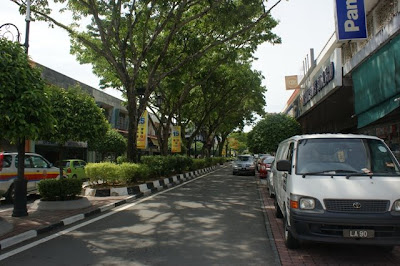
There appears to be an inexorable trend on the part of local councils to remove trees from the suburbs.
pix from here.I actually had an opportunity to bring this up some time ago with a former President of the Petaling Jaya Municipal Council. His absolutely lame reason was that trees were a nuisance because trees had a habit of dropping branches during thunderstorms! This caused an inconvenience to the local councils which had the responsibility to clean up after the irresponsible trees.
I was too flabbergasted and, too polite, to add to the obvious; that trees also had the annoying habit of dropping leaves and twigs which, also had the annoying habit of clogging up drains. Clogged drains had the corollary annoying effect of creating unhelpful puddles in roads. And, puddles have the annoying habit of forcing hydrophobic motor vehicles (or, is it hydrophobic drivers) to swerve to avoid the puddles. And, swerving motor vehicles have the annoying habit of causing bottle-necks which, have the annoying habit of causing traffic jams. I really was too polite to state such obvious chain reactions. After all, he had recently been conferred his Datukship and, I really didn't want to be rude.
So, there you have it. Trees are bad for local councils.
Will some one explain to local councils that ratepayers pay assessments for a reason? Or, do local councils actually believe that assessments are "grants" from the ratepayers for discretionary use by local councils?
The fact that trees are Nature's grand verdant visages are completely beside the point.
The fact that trees provide shade against the harsh Tropical glare of Phoebus is also beside the point.
The fact that the shade of trees provide an air cushion of cool air that cools the overall environment is irrelevant.
The fact that trees absorb water from rainfall and reduces water run-off that fills drains up is also not relevant. The list goes on...
But, palm trees, on the other hand, are all the rage. Why? Easy to pick the odd frond that drops off.
No shade, never mind.
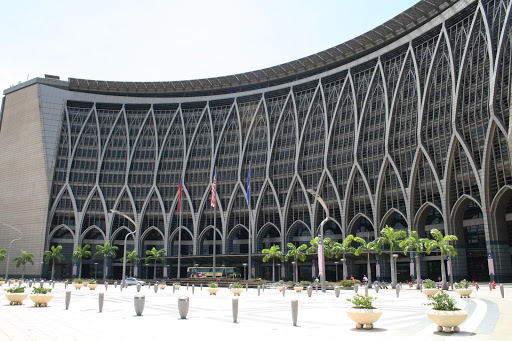
Thus the Dubai-fication of Malaysian suburbs is an inexorable trend.
And, not just the suburbs. Putrajaya is an excellent example of Dubai-fication. Park your car across the road from the Ministry of Finance and walk across the extremely wide thoroughfare under the hot, enervating glare of the angry tropical sun for a high-powered meeting and see if you can survive...barely.
Maybe that's why I so love watching P. Ramlee movies. Even in monochrome, the visage of lush trees along the roads in the Malaysia of the 1960s is just too irresistable to the eye.
pix from here.Is that the vision of a Malaysia that is lost to History?
But, why should it be so?
Why is it that down South, Singaporean roads are so boulevardy and Malaysian roads are so Dubai-y? Why?
Why are Malaysian local councils so idiotic and myopic on things as simple as landscaping in the tropics?
Could, perchance, the answer lie in the fact that local councils are not accountable any ratepayer?
Could it be that since local councillors are NOT popularly elected they don't give a shit about their lack of popularity?
Monday, February 23, 2009
Paving the correct way
Pavement stones are ridiculous in when used in Malaysia. Firstly, the foundation or underlay of Malaysian sidewalks is of dubious design. More likely, the sub-sub-sub-contractors that construct the sidewalks have cheated on the specifications.
Second, (related to the first point) the pavement stones are laid on a thin layer of sand. Maybe there's a slight layer of concrete. But, it's basically a layer of sand.
The whole unwieldy sidewalk starts to buckle after several thunderstorms. Obviously that loose layer of sand shifts and gets silted away by the torrential water run-off during a storm. What is left are pavement stones that either stick out in odd places ready to trip the pedestrian over or, sunken into a dangerous depression, waiting to break the pedestrian's neck.
I can't even imagine how Malaysian women wearing high-heels can stay upright walking on buckly Malaysian sidewalks.
Nice to look at, but horrible to maintain
And, as we know, Malaysia is very good at constructing things. But we are crap at maintenance.
Why are Malaysian local councils so fond of pavement stones? Is there a scam involving manufacturers of stone pavers?
Concrete pavements
In more advanced countries, concrete pavements are used. The specifications are actually in place. I looked it up. The Jabatan Kerja Raya (Public Works Department) has a set of Guidelines to the Design of Plain Concrete Pavement.
So, it is not as if I am suggesting anything radical.
The local councils should look into using poured concrete or concrete slabs as the material of choice for constructing sidewalks instead of pavement stones...unless there's a scam that persuades them to prefer pavement stones over concrete pavements.