Wednesday, December 17, 2008

Stay the course on English

It appears that there are 7 options for the Minister of Education to mull over:
  1. To continue teaching and learning of Maths and Science in English as it is now.

  2. To use Bahasa Malaysia or pupils' mother tongue as the medium of instruction from the primary school level and English for Maths and Science at the secondary level.

  3. To start using English for Maths and Science from Standard Four right into the secondary level.

  4. To use Bahasa Malaysia or mother tongue at the primary level, and Bahasa Malaysia fully at the secondary level.
  5. Schools to determine the medium of instruction for Maths and Science.

  6. To use Bahasa Malaysia or mother tongue from Standard One to Three, implement bi-lingual use from Standard Four to Six and full use of English at the secondary level.

  7. To abolish the Science subject from Standard One to Three and incorporate teaching of Science in other subjects.
I say just stay the bloody course and stick to Option 1.

None of us will ever, ever lose our identity, ethnicity or nationality. We are who we are. That will never change. But we should think of the future of our children.

Stay the course. Stick to Option 1. That's all I'm saying.

Tuesday, December 16, 2008

The Numerati and Pitfalls

American authors, true to their market-centred environment, are very good at coining terms and phrases to the constant despair and annoyance of the lexicographers at Oxford, I'm sure. Stephen Baker, author of The Numerati surely falls squarely into this category.

In Baker's book the Numerati are not some sinister, underground amorphous global conquistadors. Rather, they are geeky members of a global elite who are busy analyzing our every move. They're rummaging through mountains of data, looking for patterns of our behavior so that they can predict what we might want to buy, who we're likely to vote for, what job we'd do better than our colleagues. Some are even matching us with potential lovers. The Numerati are masters of symbolic realm. They're great at math and computer science. The Googleplex is crawling with Numerati. So is IBM.

Psychohistoric parallels
As part of the science fiction trilogy, the Foundation series (which was later expanded into a 5-part or 6-part series that included a prequel), Isaac Asimov's original protagonist, Hari Seldon conceived of a new psycho-science called psychohistory which was supposed to combine history, sociology and mathematical statistics to make (nearly) exact predictions of the collective actions of very large groups of people. Sounds rather like the Numerati, doesn't it?

.

It is the second book of the series, the Second Foundation, that I want to highlight. Hari Seldon had mapped out the different challenges that the new civilization would have to deal with in each phase of their development. Seldon had made these forecasts and projections via his skills with psychohistory. Every few decades, at a designated time, the leaders of the Foundation would gather before a vault that would open to reveal a holographic image of the oracular Seldon which would, then, guide the civilization through another few more decades of challenges.

But, in due course, a nemesis appeared that was not predicted by Seldon. This left the leaders of the Foundation in a dilemma that they had to deal with all by themselves.

Forecasted events and reality had diverged. There was a disconnect.

The asinine nature of assumptions
In any exercise involving the future, whether it is a basic SWOT analysis or a complex econometric model on where the flashpoint for the next world war will begin, assumptions have to be made.

This is where all crossroads meet, if you ask me. A mathematical genius with a poor understanding of historical nuances will make a different set of assumptions from a philosopher-historian. A religious zealot will make a different set of assumptions from a political idealist.

There is also a general tendency to place too much reliance on historical data even in situations of crisis and turmoil.

There is a failure to consider that a crisis is clear and incontrovertible evidence that all historical data should be suspect.

Would the Numerati have the wherewithal and wisdom to discard historical data in the event of a crisis? And, without such data how does one do forecasting?

Forecasting or fraud?
With this understanding it is no wonder that Malaysia's economic managers and, all economic managers the world over, keep trotting out last month's or last quarter's data.

But, the cardinal sin is to rely on the past data to paint rosy pictures of the immediate future.

Monday, December 15, 2008

Bad decisions

This is the season when we begin to read news about bad decisions being made by people that were widely regarded as smart and savvy. For instance, why did IOI Corp put down a non-refundable RM73 million to buy the Citibank building only to walk away from it? Why do business owners doggedly refuse to downsize and negotiate haircuts from banks to live for another day? Why don't some politicians see the writing on the wall and resign with grace and timeliness?
.
Certainly arrogance is to blame. The Asian face-saving is always a feature. Emotional attachment is also relevant. Taking into account stale facts is another.

Using stale facts
This last factor is very relevant of late. We have seen a landslide electoral victory in 2004 bearing no resemblance whatsoever to a narrow 2008 victory for BN. We have seen economies that projected 5.5% GDP growth being revised and, revised and, revised to lower projections with each passing month. These are evidence of reliance on stale facts to make key decisions. To be fair, key factors are shifting at frequencies approaching nanoseconds throughout 2008. But, that's how things are in the Electronic Age. No excuses are acceptable.

http://lh3.ggpht.com/choongkeat/R9R_1EvSzZI/AAAAAAAAA5U/3Tv08n7Nicw/s800/Parliament+results+02.jpg.

Faulty brain wiring?
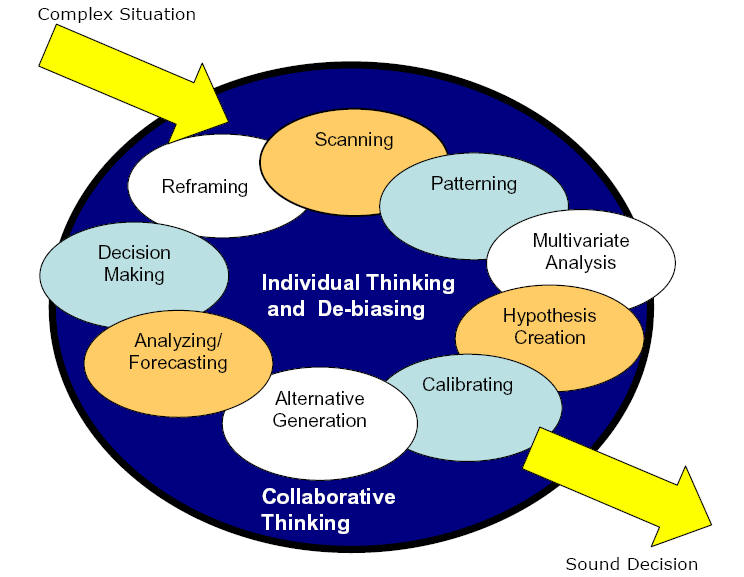
Management guru Sydney Finkelstein, a professor at Dartmouth's Tuck School of Business, has another interesting perspective. He believes that bad decisions stem from the way our brains are wired. He delves into the complex world of neuroscience, a hot topic these days. But while much ink has been spilled on neuroscience and how it relates to investment decisions (buy, hold, or sell?), Finkelstein feels that few have applied the emerging science to management decision making.

Given the horror stories coming out from Wall Street, for instance, some pretty horrendous decisions were made by CEOs such as Lehman Brothers' Dick Fuld and Stan O'Neal of Merrill Lynch.

What led these seemingly brilliant men to make such lousy calls? Finkelstein has identified four internal biases that often lead to bad decisions:

  • inappropriate prejudgments;
  • inappropriate experience;
  • self-interest; and
  • attachments, sentiment or emotions.

Precipitous Pitfalls
The first two are the most interesting. Prejudgment happens when we choose a course of action and ignore any advice or information that does not follow a predetermined path.

Inappropriate experience, meanwhile, is basically a What worked before will work again attitude that's unfortunately quite common in executive boardrooms and political backrooms.

Finkelstein feels it helps explain why financial firms got more and more enmeshed in subprime loans and collateralized debt obligations in the US. It's not just arrogance—the leaders made these bad decisions because they were right before. But it becomes dangerous when leaders do not heed the warning signs and rely on stale facts.
http://www.uab.edu/images/uabmagazine/fall05/13a.jpg.
Lehman Brother's Fuld, Finkelstein argues, perfectly encapsulates the experience bias. Fuld was unable to break out of his own experience and history by seeing the risks that Lehman had.

Another example is Jerry Yang of Yahoo!, who, Finkelstein argues, cost shareholders billions by stubbornly holding out for a better deal from suitor Microsoft , which then walked away from the table. In that situation, the bias Yang displayed was attachment to the company he helped create and last year stepped back in to save. Microsoft's Steve Ballmer was smart to walk away.

There are many Malaysian examples. I won't name names or give any further examples. Malaysians get testy when put in the spotlight. We'll just leave them to wallow under their respective tempurung.

Some advice to note
What advice does Finkelstein have for leaders coping with the economic downturn, commercial and political? Rather than hunker down, he thinks leaders should act boldly.

http://www.bizforum.org/whitepapers/IA-1-p3.jpg.

People are more willing to accept change during a crisis. This means it's an opportunity to make hard changes that we need to make that may have been resisted before.

One caveat, though, we need to check biases at the door before we make those hard changes. Can or, not?

Answering a clarion call?

I wrote this in 2003 when I flirted with the idea of joining one of the local think tanks. Needless to say, I didn't join any such outfit. I just re-discovered this when I was doing my virtual housekeeping. I must beg your pardon in advance for the sophomoric quality of the piece. It was written with male bovine droppings in mind...
________________________

An advertisement by Malaysia’s foremost think-tank that is written in a robust and forward-looking manner resonates with non-indolent Malaysians. The challenge of preparing a hasty manifesto, a veritable wish-list of things one wants to see happen … it IS a challenge. Let’s see how this thought process pans out.

I’m sitting in the study surrounded by books. They are, in many ways, the sum of private reading over the past 23 years of my 41 years of existence. There are books written by Americans that reflect a long fascination one has with the post-World War II era of Pax Americana.

Many of these books focus on the biography of John F. Kennedy, the ones written during the man’s life and in the aftermath of his death having varying degrees of hagiographical slant. Latterly, the focus appears to be directed at the tawdry details of the man’s personal and sexual proclivities which suggests two things about contemporary America; the first, being the “dumbing down” trend of sensationalism and the sheer ennui of American suburbia.

This offers a market to authors who produce pretentious dribble to satisfy the wanton fantasies of suburban American housewives. The second, a more sinister one, suggests a conservative Republican illuminati of sorts that has a singular desire to destroy the most potent symbol of erstwhile American liberalism, JFK the man and the Kennedy clan as a whole.

One recalls the sheer doggedness with which Bill Clinton’s tenure was tainted by allegations of sexual and financial waywardness. Clinton was, it must be remembered, able to parlay an 18-year old’s handshake with JFK into a passing-of-the-torch symbolism that resonated beyond loyal Democrats. It is possible that this same grouping fostered the attacks by the US on Afghanistan and Iraq.

Another set of books (almost mandatory for “thinking” Malaysians) are devoted to politics and economics in Malaysia. Many recent acquisitions are on Sarawak. The book that stands out would have to be Gordon P. Means on Malaysian Politics.

Together, the early collection of this category of books generated an adolescent’s impulse to become a lawyer (because politics and policies, in the end, become legislation and, legislation are laws; thus who can better understand the process but a lawyer; or so, the young man thought).

Sadly, it appears that the best writings on Malaysian politics and economics are by non-Malaysians. It would seem that contributions by Malaysians are confined to hagiographical and one-dimensional works that are heavy on rhetoric or, angry works that struggles to rise above the fray to attain a degree of objectivity in analysis but usually fail to do so. Maybe, its is the turn of phrase (or, the lack thereof) that makes local authors seem ordinary. In any event, any work on Malaysia is welcome in my collection since there are so few.

The rest are eclectic; law books (because one ply’s the trade), science fiction (because one cannot accept a bleak unStar Trek-like future), chinoiserie to establish prodigal ethnic roots and so on.

So, here it is, a partial bibliographical summation of readings that, when coupled with the experience of living and working in Malaysia, leads to a desire for the maintenance and perpetuation of the status quo and trends such as they presently exist. Malaysia is a wonderful place despite its imperfections. And, what are these imperfections?

  • A “near enough is good enough” mindset – Our approach to work and play is lackadaisical. There is no pride in what we do. We may build magnificent structures that reflect national ambition, but it is the little details that we tend to overlook or ignore. I had the opportunity to attend a meeting at the Prime Minister’s Office at Putrajaya. Upon visiting the washroom beside the waiting room to the PM’s office I noticed to my dismay that one of the washbasins had a leaky and shaky faucet and part of the floor was wet. We build but we fail to maintain. This mindset is reflected in many aspects of Malaysian society, from sports to hospitality to industry.
  • Active engagement between communities – Islamic fundamentalism and Chinese chauvinism are the principal culprits that threatens to create a “one country, two systems” ethos that is dysfunctional and, worse, threatens national harmony. While threat of terrorism and the vast Malay-Muslim population has made the dismantling of madrasahs a priority, in the near-term, the Chinese education problem needs to be addressed. Chinese schools are continuing to create marginalized, non-mainstream Malaysians who are myopic. Just like their Muslim fundamentalist counterparts, their fringe-based perspectives may deteriorate into a social maelstrom that will suck away social stability. Further social engineering need to be put in place and carried out.
  • An open economy and inevitable globalisation has many dangers – As a small country with the psyche enumerated above, we are completely unlike the Swiss nation. We do not have the genius nor the industry to match up with the competition that will arrive in a few short years. The first phase of the WTO paradigm will be our becoming a nation of employees. Many of our industries will capitulate to superior imports, of labour and products. The compelling question is, will it be a case of “two steps back, three steps forward” or will we forever be employees in a neo-colonial design? The increasing flexing of superpower might by the US is provoking a response from Europe. It is likely that a bi-polar world will develop within a decade. But where does that leave the Orient? The likely emergence of a new era of American and European imperialism with China and Japan as cohorts cannot comfort us in sunny Malaysia. Under which “sphere of influence” will non-aligned nations like us end up in?
  • Maintaining Malaysia’s international reach despite a weak economy – As the Mahathir era wanes our collective pride in the ascendant position of influence in international affairs will be threatened not just from the great powers but also from within. A weak Malaysian economy will make us a lame-duck since domestic issues are key to maintaining political power. The key challenge is to be able to successfully parlay our influence vis-à-vis these competing great powers and translate these relations into tangible economic benefits in the form of preferential trade terms and commercial reciprocity.
At the end, my deepest motivation is to secure a sound future for my children who are Malaysians to the core; a motivation from such a deep place as only the emotions of a parent can reach.

There is a call to Life a little sterner,
And braver for the earner, learner, yearner.
Less criticism of the field and court
And more preoccupation with the sport.
It makes the prophet in us all presage
The glory of a next Augustan age
Of a power leading from its strength and pride,
Of young ambition eager to be tried
Firm in our beliefs without dismay,
In any game the nations want to play.

-Robert Frost, For John F. Kennedy-His Inauguration-

Saturday, December 13, 2008

Silly season

I know the silly season has arrived when I read this report, Chinese educationists threaten protest over English usage.

The silliness is even more pronounced by the scenario shown by this op-ed piece in Malaysian Insider entitled, Speaking in tongues.

The basic proposition in the op-ed piece is, how are these Mandarin language, anti-English language chauvinists going to communicate their grievance to a general public in Mandarin?

I suppose the Dong Zong or Jiao Zong buggers can also communicate their grievance in Bahasa Malaysia. This should bring a warmish sort of glow to the hearts of the other buggers at Dewan Bahasa dan Pustaka.

I guess us English-proficient buggers are in the minority. That is why we can't afford to be silly. We shall have to stick to being knowledgeable and wise I guess...

Leadership: Never Waste A Crisis

Despite all the different issues that top leaders are facing, there is a commonality to great leaders in times like these. It can be summed up in the phrase used by Rahm Emanuel, Obama's Chief of Staff-designate, Never waste a crisis.

None of us yet know how hard the economic challenges are going to be, in 2009. But beyond the current events lies interesting opportunities.

What steps can leaders take to move on the opportunities, while at the same time paying attention to all the demands of the moment? What can great leaders do to move decisively forward in a world turned upside down?

http://www.poster.net/anonymous/anonymous-leadership-5000373.jpg.

First, figure out how to survive. Given that, leaders need a plan that allows them to move fast, faster than before.

Many economies either didn't see or didn't believe common metrics of economic and financial distress before the recent crash and crisis. What metrics should a leader be looking at now? Which ones from the past still give useful leading indicators? What else might leaders need to look at?

Leaders need to be systematic and transparent about balancing optimism with realism in the current plan for economic stimulation.

A good leader must increase his or her forums for listening at the edges, for creative dissent. The leader must ensure that he or she has an inner circle of people who will never allow the leader to fall into the destructive cycle of hubris and denial.

Second, the leader needs to ask what can be done now that couldn't be done before. This is the crux of successfully taking advantage of a world turned upside down. How can the leader position himself or herself now, so that he or she will be better off than before, once the turmoil is over?

Does the current turmoil accelerate and even necessitate major shifts in tactics and strategies in the next 12 months--shifts that better position the whole party or organisation but would have been impossible to execute just six months ago?

Does this crisis allow the leader to dramatically improve loyalty? Are there things the party or organisation can do that will make a difference to people caught in these difficult times?

And within the leader's own organization, is the leader facing squarely how quickly the dynamics of talent retention have changed?

What might a good leader do differently to increase the party or organisation's talent base?

The leader needs to ask himself or herself: Might this be a time to promote some of the best high potential people, without worrying if someone else feels passed by?

This is an opportunity for the leader to reorient the party and organization around value, in terms of roles and responsibilities.

http://www.natcapwfs.org/images/leadership.jpg.

No whining. The leader may find himself or herself thinking, more than once, I didn't create this crisis. Why me? Why should I be stuck with dealing with it?

It's very tempting to feel aggrieved, but, instead, the leader should step back and ask himself or herself in the truest spirit of Norman Vincent Peale, Why not me?

Leaders in crisis put aside that very understandable anger and instead are glad, even honored, that they are in a position to respond to a once-in-a-lifetime set of circumstances.

The leader needs to remember that the people around him or her may be dealing with the fallout of the crisis in many ways that may not be visible. The leader needs to have compassion for them, and mitigate their hardships with opportunity, inspiration and the call to hard work.

Beyond this crisis is a new landscape, one that will define the arcs of opportunity and prosperity for decades to come.

The leader needs to uncover the opportunities that reach beyond survival, guide the country, economy or organisation to get there and extend a helping hand to as many as possible along the way.

The costs of the economic turmoil are high--way too high to go to waste.

P.S. The above may also be applicable to political turmoils.

Wednesday, December 10, 2008

English in education: The continuing saga

I am in full agreement with Zainul Arifin's latest op-ed piece as I have been with all his previous pieces on the matter of education in Malaysia. I'm just glad that Zainul has a space to articulate his views on this matter.

THE Chinese-education lobby group Dong Jiao Zong, according to a news report, is threatening a nationwide protest should the government decide to continue with teaching Science and Maths in English.

The group and many others want to revert to Bahasa Malaysia in national schools, and Mandarin and Tamil in vernacular schools.

If the report is true, Dong Jiao Zong's threat can be seen as a pre-emptive strike to put pressure on the government, ahead of the Education Ministry's fifth roundtable meeting for stakeholders on Dec 16 to get feedback on whether to continue with the policy

Political parties and various other groups have also weighed in, many siding with Dong Jiao Zong, though none has threatened as blatant a show of dissent as it has in promising to gather opponents of the policy for a nationwide protest if the current policy is not reversed.

The leaders of Dong Jiao Zong know how such a threat would play out in public, but the fact that it does so anyway suggests either naivete, or arrogance. And I do not believe it is the former.

I thought the recent Ujian Pencapaian Sekolah Rendah (UPSR) results, which was to be a key factor in determining the fate of the policy, showed that it was not damaging and that more students answered their questions in English. Interviews with students, which I must admit could be misleading, suggested that they preferred the subjects to be in English.

Read the complete piece here.

Retrenchments, pay cuts & knowledge workers

Let us assume that 2009 is not that rosy. Let us also assume that some employers may have a need to trim costs or, Heaven forbid, slash costs due to pressures of declining sales turnover.

One of the largest cost items in any organisation's profit and loss statement is labour or staff cost.

There are only 2 ways to deal with labour cost. One way is to institute retrenchment. Some employers use the unsavoury method of putting extra pressure on staff to force them to leave.

Another way, more enlightened, is to institute pay cuts.

The management guru Peter Drucker suggested that cost-cutting should be a routine exercise. It shouldn't be something that management does only during downturns. Drucker said, Businesses that actually succeed in cutting costs don't wait until they have to cut costs.

While watching costs and bottom-lines employers need to be more enlightened not just in the best of times but, even in the worst of times.

Investing in Knowledge Workers
Investing in productive assets should be a regular, everyday function. A modern organisation's greatest asset has to be its knowledge workers. It's human resource. It's human capital.

Rick Watrzman of the Drucker Institute gave the example of K.H. Moon, the former chief executive of Korean consumer-products maker Yuhan-Kimberly.

It was during the late 1990s, amid the Asian financial contagion, that Moon looked around and was disgusted by what he saw, that at almost all companies, the management just followed the old wisdom—massive layoffs.

Yet Moon felt that simply to slash employment was irresponsible, and he began to persuade his colleagues that there was a better way to go—not just to survive but to grow and prosper. He felt that it wasn't the correct time to lose jobs but to build capability, personally and companywide.

To get there, Moon took several bold steps. One was to accelerate a push to a new staffing system, moving from a three-crew, three-shift arrangement to a four-crew, two-shift model. By spreading out the work this way—Moon has likened it to job sharing in Western countries. The company figured it has been able to employ 25% more mill workers than it otherwise would have.

http://www.roell.net/publikationen/EfimovaFrameworkKnowledgeWorkAnalysis.jpg.
Lifelong Learning
Because of this setup, employees work fewer hours overall. But they're encouraged not to be idle.

Yuhan-Kimberly pays for them to attend classes so they can improve their technical acumen as well as increase their general knowledge. It's all based on a philosophy of lifelong learning which was regarded as the company's true source of competitiveness and sustainable growth.

This counterintuitive approach to dealing with human resources has much to commend it.

The upshot is that by providing a healthier work-life balance, by giving the rank-and-file the opportunity to enhance their skills continually, and by taking other steps to create a self-directed team culture, Yuhan-Kimberly has seen job satisfaction among its 1,700 employees soar.

So has productivity (along with market share and revenue)—so much so that workers' wages have also risen substantially.

This formula won't work for everyone; implementing it involves real costs and, thus, real risks. What's more, there's no avoiding the fact that layoffs are inevitable during a recession, no matter what is tried.

Even Drucker, who so admired Japanese industry for its commitment to lifetime employment, recognized this ideal was bound to crack amid the unrelenting pressures of globalization.

But what Yuhan-Kimberly reminds us is that shedding thousands of positions doesn't necessarily have to be management's automatic response to a bleak economy. When things seem darkest, it's time to innovate, not just eliminate.

Think about it.

Tuesday, December 9, 2008

Najib eager to avoid Fourth Floor syndrome

This Malaysian Insider report entitled Najib eager to avoid Fourth Floor syndrome is interesting in the aspect of skullduggery and speculation. Reports like these are indulgent of the chicanery and gossip-mongering that typifies politics and governance in Malaysia.

If we were to trouble ourselves to look at this matter from the prism of governance, it will be evident that the presence of personalised advisers with such proximity to the leader emulates the style of constitutional democracy practiced by the United States of America.

In the US model, the Executive branch of government is formed by 2 elected politicians, namely, the President and the Vice President. The President, in particular, has a carte blanche discretion to appoint personal advisers and Cabinet members. The personal advisers are directly appointed. Cabinet appointees have th sucessfully run the gauntlet of scrutiny of the Legislative branch of government in the form of the Congress.

Lest we conveniently forget, Malaysia practices a parliamentary democracy that originated from the Westminster model from the United Kingdom. A Prime Minister, in this model, may have political secretaries and parliamentary secretaries. Private secretaries are also employed. But other types of advisers that have no official role are regarded with great scepticism.

Our first three Prime Ministers practiced governance in the conventional parliamentary method. The departure from this approach came with Dr M who leapfrogged past the official coterie of support staff and inner office staff. It may well be that as the innovator of this decidedy un-parliamentary and un-Cabinet and un-Civil Service approach, Dr M was, in turn, sceptical of the calcified characters clinging to the corridors of power.

Dr M, as we all know, was at all times a political leader in search of a fresh perspective. He was an exemplar of (with apologies to Robert Frost) the road less traveled. In so doing, he sought and, consistently acknowledged personalised advise. In this sense, Dr M created a precedent of sorts.

Given that Dr M's shadow writ large for more than 2 decades it should not be too surprising that this aspect of, what I am calling, extra-Executive approach to governance, particularly on economics management and policy-formulation, came to be regarded as the modus operandi by his immediate successor.

Perhaps it is just as well that this so-called Fourth Floor issue is lingering because, like anyone who reads the Tao Te-ching will be aware, by pointing to the thing that is apparent, we also show what is absent.

http://bulgar.no-ip.info/downloads/snimki/wall/Office%20of%20the%20Prime%20Minister,%20Putrajaya,%20Kuala%20Lumpur,%20Malaysia.jpg.

What is absent and, has been absent for far too long is the twin departments that had proven to be so invaluable in past administrations. They are the Economic Planning Unit (EPU) and the Implementation and Co-ordination Unit (ICU).

Remember EPU and ICU?
http://www.epu.jpm.my/New%20Folder/image/logoepu.gif.

Whether it is a branding issue or, otherwise, I'm not sure. But in 1997 the NEAC was created. It tended to supplant the EPU.

Now we have an Economic Council which is also supplanting the EPU.

The EPU is now a mere shadow of its former self. It has become a rubber-stamp to put into its letterhead the proposals originating from the advisers. EPU's current role is so restricted that the impression one gets is that now the EPU only prepares FIC Applications and modifies FIC Guidelines.

What has happened to the EPU and ICU?

If there is calcification in the rank and file then, change the staff.

To borrow a phrase from David Halberstam, EPU and ICU and the rest of the Prime Mnister's Department should be employing the best and brightest.

Then and, only then, can future Prime Ministers wean themselves from this need for extra-Executive advisers...unless there are other reasons for retaining such advisers that escape my limited imagination.

The banking crisis

Steve Hanke has done an interesting report in Malaysiakini in his piece entitled The banking crisis. His report describes various scenarios being experienced in various jurisdictions in the Asia-Pacific region.

To add another angle to the phenomenon that Hanke has described, we should look a little deeper into the nature of banking and finance.

It is very important to remember that banks and financial institutions exist to make profits. Their economic role as financial intermediaries is to accept money deposits and to lend the money by imposing an interest charge.

In their role as lenders, banks require collateral. The most common form of collateralisation is property or landed assets.
http://homepage.mac.com/helipilot/.Pictures/vistasaereas/MontondeCasitas.jpg.
It is, therefore, no wonder that the current global financial crisis began with a property-related collapse.

When central banks permit easy credit and lending, banks will tend to support the property development and housing sector. It is easy to collateralise such loans. This fuels of the housing and construction boom that leads to a bubble.

When the bubble bursts as they inevitably do, because everything is cyclical, there is a financial crisis.

It does not help that the conventional wisdom over the past 30 years, is to create new financial products which are derived from primary financial products such as housing loans.

The secondary financial product from housing loans is the mortgage-backed security. This is where Fannie Mae and Freddie Mac came into the picture. In Malaysia, we have Cagamas. At this level things are still okay actually.
http://i2.cdn.turner.com/money/galleries/2008/fortune/0804/gallery.F500_losers.fortune/images/fannie_mae_hq.la.jpg.
The real problem of unwieldiness comes when banks create even sexier derivatives over and, above, the mortgage-backed securities. In the US, they invented the collateralised debt obligation (CDO) and credit default swap (CDS) as new, sexy financial instruments.

While mortgage-backed securities are basically bonds that allow banks to have more liquidity to provide eve more lending, this secondary market is still easy to monitor.

But, when it gets to the level of CDOs and CDSs, things get really hairy. As I have said in earlier postings, there is no risk management algorithm, even with multiple Cray supercomputers, that can predict risk outcomes at the level of CDOs and CDSs given the fact that such products are exposed to so many variable factors.
http://bionic.pmhclients.com/images/uploads/WindowsLiveWriterSyntheticCashCollateralizedDebtObligatio_136ABimage_2.png.
Anyone with a rudimentary understanding of algebra or any mathematical equations will know that if there are too many variables in the equation, it becomes more and more difficult, if not, impossible, to arrive at a specific result.

That, is a very good reason why, to reverse-paraphrase the character Gordon Gekko in the movie Wall Street, greed (or, profits) - for the want of a better word - is not good. But, we'll leave that for another time.

Monday, December 8, 2008

Structural unemployment (Part 2)

etheorist was kind enough to point out to me that one of the key factors that causes structural unemployment is not only a matter of skills training or re-training per se, but, that sometimes economic policies direct resources one way and, graduates are focusing on skills that go another way.

For example, the Malaysian government appear to be fixated on the construction and property development sector as if it is the main driver of Malaysia's future. It cannot have escaped your notice that the economic stimulus package unveiled by the First Minister of Finance was primarily directed at the property development sector.

But, who do the property development sector employ mostly? Foreign construction workers. Sure, there are architects and engineers and building materials suppliers involved. But, is this the best sector to stimulate? Where is the magical multiplier effect in the property development sector?

It appears that the Malaysian economic managers believe that foreigners buying Malaysian properties will offer the panacea. That is why the FIC Guidelines on residential property investment is being relaxed.

I fail to see why our scarce economic resources should be directed at an economic sector that has not demonstrated any major strategic forward planning. Every time there is an economic downturn the property development lobby will lobby the hardest for government rescue, either in the form of financial stimulus, bank borrowing and lending or relaxation of policies.

And, during the good times they carry on building as if there is no tomorrow.

Where is the economic planning and management? Where is the regulation?

In the wake of the Bukit Antarabangsa tragedy will there be any concerted move by the economic managers to deal with the property sector? It shouldn't matter that town planning and building and drainage belongs to the state and municipal authorities. The entire government machinery, from the federal, state and municipal level, needs to act in concert for the sake of the life and limbs of everyone, Malaysian or foreign.

Back to the issue of structural unemployment. The economic managers will do well to ask why graduates are unemployed (leaving aside the other issue, employability).

Could it possibly be that Malaysia's economic resources are directed towards generating economic activities that promote low-cost and not-so-high skills and venues that attract only certain types of FDIs that are only interested in such factors?

I don't know. I'm just wondering aloud.

Saturday, December 6, 2008

Full employment and structural unemployment

It is a theoretical given that since Malaysia has millions of foreign workers, there should be no fear of unemployment. Yet, even in the best of economic times, Malaysia has a 3% rate of unemployment.

Why is this so?

The obvious answer is the phenomenon of structural unemployment. Structural unemployment is regarded as a long-term unemployment phenomenon that arises from imbalances between the skills and other characteristics of workers in the market and the needs of employers.

It involves a mismatch between workers looking for jobs and the vacancies available often despite the number of vacancies being similar to the number of unemployed people.

In this case, the unemployed workers lack the specific skills required for the jobs, or are located in a different geographical region to the vacant jobs. Structural unemployment is usually a result of structural change.

The government can mitigate the problem by providing an infrastructure that offers training in these areas so that the demand for these jobs can be met.

This is where technical colleges and institutes are very important. They have an important economic role to ensure more Malaysian workers can have the opportunity to increase their skills, which in turn increases the supply of labor in skilled areas.

But, how available are these technical colleges? The resources seem to have been poured into building universities. Vocational and tradesman skills seem to have been neglected. Why is this?

Perhaps the Minister of Education and the Minister of Higher Education can explain this. And, while we're at it, can someone please explain again why there needs to be two education portfolios?

In the coming few years, the economic challenges are going to become worse. No, Datuk Seri Najib, I'm not talking Malaysia into a recession. I am addressing a key economic management issue.
http://www.robrogers.com/cartoons/2003/images/052203%20Unemployment.gif.
Malaysia's economic managers make platitudinous comments about skills training and knowledge capital. We can create as many tertiary graduates as we can. We can create thousand of university graduates every year. But, anyone watching war movies can tell you that it is not the captain or lieutenant that drives the platoon. It is always the experienced sergeant that really holds the troops together.

In the context of the economy, the sergeant is the trained supervisor and floor worker. These people are the real engine of the Malaysian economy. And, we need to address their needs.

And, we need to build more technical colleges and institutes to keep the feeder line of workers so that the SMEs and industrial corporations can keep moving up the value chain in terms of the manufacturing and production.

If the government anticipates unemployment in the coming year, it must surely accelerate plans for more places to re-train these workers to ensure that the phenomenon of structural unemployment is fully addressed. Are they?

Who's in charge of creating technical and vocational colleges and institutes in Malaysia?

Is it the Minister of Education?

Is it the Minister of Higher Education?

Or, is it the Minister of Human Resources?

So many Ministers, so few thinking and forward-planning Ministers.

So much politicking, so little economic planning.

This issue of full employment and structural unemployment is only one aspect. I hope to blog further about related issues such as minimum wages and the abdication of responsibility by Malaysian unions

Friday, December 5, 2008

Cautious or ignorant?

If you've taken the trouble to read all my posts under the label Economy, you may have formed an idea that I have been rather impatient and increasingly concerned with the way in which Malaysia's economic managers have been handling things.

To avoid any doubt, whenever I use the phrase economic managers I am referring, in particular, to both Ministers of Finance, the Minister of International Trade and Industry, the Minister of Domestic Trade and Consumer Affairs and the Bank Negara governor.

For the economic managers to continuously publicise HISTORICAL ECONOMIC DATA, meaning data collated from three months ago or even further back suggests only 2 possible scenarios:
  • First, the theory of caution. In this theory, the economic managers are true believers in the normative side of economics, also called behavourial economics, where mass psychology may be seen as a relevant factor. The word confidence is de riguer in this respect. What the economic managers fail to see is that if the economic boat is tanking it really does not matter that the captain calls for all hands to remain at their stations, the in-rushing waters will sweep even the most loyal hands into the stormy sea.
  • Second, theory of ignorance. In this theory, the economic managers are being fed drivel by their economic advisers and data-gathering apparatus. The economic data being gathered may be suspect. The economic data gathered is misunderstood (this is unlikely). There is insufficient expertise to analyse and understand the economic data gathered. The upshot of this is that the blind leads the blind or, more accurately, the blind feed the blind.
In either case, the management of the Malaysian economy looks pretty bad.

It is bad enough that we don't know how and why the Malaysian economy is successful. It is even worse that we don't know how and why the Malaysian economy is going into distress.

The Economic Council which now appears to be a new moniker for the NEAC, is filled with personalities rather than hardcore economists.

With the greatest of respect, how can businessmen and corporate leaders have the skill sets to advice the Malaysian government on the economy? Even I would demur to a seat at the Economic Council (not that they're inviting me) because I do not believe I have the skill sets.

People like etheorist and Sakmongkol may have better claim to a seat at the Economic Council, though I wouldn't mind sitting behind them.

I, somehow, cannot accept that the economic managers are being cautious. More and more, I am inclined to believe that they are ignorant of the economic trends and they have no real advisers to guide them with real options. It is cold comfort for the economic managers to say, Well, even the US Treasury Secretary Hank Paulson is showing that he has no clue. No. That will not do at all.

Thursday, December 4, 2008

Exports down 2.6% in October

Malaysiakini carried an interesting economic report entitled, Exports down 2.6% in October. Here's my take on the Malaysiakini report.

Given what the government's pronouncements that an challenges in Malaysia's traditional export markets may be cushioned by seeking new Asian export markets, October 2008 export figures that showed a 2.6% decline compared to the same month last year has been called unexpected.
.
What makes this decline unexpected are certain economists' expectations for a 6.3% rise in a country where trade is more than 100% of gross domestic product, or the value of all goods and services produced.

The declining export numbers is blamed on the weakening electronic and electrical (E&E) sector.

The last big fall in export numbers was in March 2007 when they fell 4.5%.

Imports
Imports for October fell by 5.3% year-on-year compared with analyst expectations for a 1.8% rise. This information comes in the wake of South Korea announcing an exports slide by 18.3% in November, the biggest drop in seven years, and amid tumbling oil and commodity prices which are key exports for Malaysia.

Impact on Malaysia's trade surplus
Exports totalled RM53.46 billion, down from RM62.31 billion in September, while imports fell to RM43.84 billion. This has eaten into Malaysia's trade surplus, which fell to RM9.62 billion in October compared with RM14.5 billion in September.

Pinning misplaced hopes on ASEAN
The Malaysian economic managers have pinned their hopes of avoiding a recession on boosting exports to Asia. But the sickening reality is that the October data showed exports to the 10 countries that make up Asean fell by 6.1% from a year ago and exports to China fell to RM4.89 billion from RM5.26 billion on weaker commodity and oil prices.

Growth or decline?
Malaysia's economic managers has expressed the hope of recording economic growth of 3.5% in 2009.

I am inclined to believe that Malaysia will be lucky to post zero growth. Flat is the new up. Zero is better than negative. Such are the times that we live in.

Impact on monetary policy
Like many, I am hoping that the poor trade data will cause the oracular Bank Negara governor to further cut the overnight bank lending rates (OPR) from the current 3.25% to 2.75%. That is a 50 basis points reduction.

But, knowing Bank Negara, they will go inch-by-inch. So it will be 25 basis points, then, wait-and-see, oh shit!, reduce another 25 basis points, then, wait-and-see, oh shit! oh shit! (the last two was added as a mischevious afterthought since this blogger is not employed in the banking sector and, can claim immunity).

Wednesday, December 3, 2008

Meeting Sakmongkol AK-47

Monday went by uneventfully. Tuesday crawled past with equal blandness. I was resigned to the likelihood that walla may have received a garbled message from Sakmongkol that we could all meet for a cuppa and a solid round of camarederie.

I had chosen today for errands. The mundane everyday stuff of living. Then I get a call from brother walla that Sak was on for a get-together at 1.30 p.m. So, I did have a chance to meet Dato' Sak after all.

For good measure, I made sure that regular commentator ben was able to join us. After all, it was ben that had drawn my attention to Sak's blog. We're both fans.

I cannot begin to describe how much pleasure I had to have met Sak this afternoon. And, to catch up with the great walla again was more than fine.
http://www.yowazzup.com/food/images/little-penang-kafe/sugar-cane-cincau.jpg.
What surprised me most is that Sak was exactly as I expected him to be. Contemplative, courteous and well-deported.

I had an urge to tell him that if only the average UMNO pol was even half the measure of him, the party would be chugging along with great aplomb and popularity. But, I didn't.

Instead, I found myself trying to do what I enjoy doing, making remarks that will bring a laugh or two from the great Sak. To my great pleasure, I achieved it once, twice or, maybe more. That made the tete-a-tete even better.

To shake the hand of the person that constructs such complex thought, reasoning and analysis at his blog was a great honour.

The only blemish to an otherwise pleasurable first meeting was that mamasita wasn't available. I hope we can remedy this the next time.

Thanks for your time Dato' Sak, walla and ben. The pleasure was very much mine. When's the next time?

Tuesday, December 2, 2008

Reduce income tax (Part 2)

Here's an interesting albeit still pioneering finding by Andrew Mountford and Harald Uhlig (a prominent econometrician now at the University of Chicago) in an empirical study called "What are the Effects of Fiscal Policy Shocks?":

Our main results are that:
  • a surprise deficit-financed tax cut is the best fiscal policy to stimulate the economy.
  • a deficit[-financed government] spending shock weakly stimulates the economy.
  • government spending shocks crowd out both residential and non-residential investment without causing interest rates to rise.
Greg Mankiw's observation is that these finding are not consistent with standard Keynesian theory, according to which government spending multipliers are larger than tax multipliers and crowding out occurs through increases in interest rates.

In these trying times, a gradual income tax reduction from the current 29% top rate to an 18% top rate might just be the good stimulus that the Malaysian government should seriously consider.

The lower income tax rates will be offset by increased economic activity and, therefore, greater income tax collections.

It will do the Malaysian government well to remember that necessity is the mother of invention and the mother that gave birth to the ultra-radical capital controls and de-pegging of the Ringgit  in 1997 (I'm certain that he has the sense of humour to forgive the maternalistic metaphor) was the redoubtable and unsinkable Dr M of Malaysia.  


Why I am proud to be Selangorian

Monarchs are a dignified element within the constitutional superstructure. I have written pieces on constitutional law so technical and boring that I am surprised medical researchers have not extolled such pieces as having medicative value for patients with sleep disorders. Click here for sleep inducement.

Most of those pieces have dealt with the role of the monarchy in Malaysia within the context of the Federal Constitution. In each, I have attempted to articulate the importance of the monarchy as a dignified element that has continued relevance in tempering the volatility of Malaysia politics.
http://www.scotstamps.co.uk/images/CWI%207/State_of_Selangor_Ensign.jpg.
Walter Bagehot has written, and here, I will challenge your ability to stay awake with this:

To state the matter shortly, the sovereign has, under a constitutional monarchy such as ours, three rights – the right to be consulted, the right to encourage, the right to warn. And a king of great sense and sagacity would want no others. He would find that his having no others would enable him to use these with singular effect. He would say to his minister, “The responsibility of these measures is upon you. Whatever you think best must be done. Whatever you think best shall have my full and effectual support. But you will observe that for this reason and that reason what you propose to do is bad; for this reason and that reason what you do not propose is better. I do not oppose, it is my duty not to oppose; but observe that I warn.” Supporting the king to be right, and to have what kings often have, the gift of effectual expression, he could not help moving his minister. He might not always turn the course, but he would always trouble his mind.
http://upload.wikimedia.org/wikipedia/commons/thumb/0/05/Coat_of_arms_of_Selangor_state.svg/419px-Coat_of_arms_of_Selangor_state.svg.png.
And now, I give you HRH Sultan of Selangor's perspective on the political nonsense that taints us all and, other current affairs.

A different kind of privatisation

What does it say about the stock market when publicly-listed companies choose to go private? I have written in my Knol that the stock market has the following basic functions within a modern economy:
  • Mobilizing and directing savings to their most productive uses;
  • Providing a mechanism for price discovery through the stock exchange mechanism and the evaluation of market information;
  • Facilitating the management and pricing of risk;
  • Assisting potential investors in assessing and making investment decisions by reflecting risk in the pricing of shares and other equity instruments; and
  • Facilitating capital raising by corporations.
When publicly-listed companies choose to reject their listing status at Bursa Malaysia it means that any or, all, of the above factors are not in play.
http://cache.daylife.com/imageserve/0evV2527uZbOp/610x.jpg.
It also shows 2 things:
  • A stock market is a good time buddy. The stock market is active only during the good times when there is plenty of money.
  • A stock market is an inefficient price- and value-identifying mechanism when sentiment is weak or, there is no confidence.
Thus, when people say that the stock market is a barometer of economic confidence we have to take that statement with huge doses of salt even if it leads to high blood pressure.

For, stock markets are a poor barometer of confidence. Real confidence lies in the real economy.

Economics is boring until...

Gutter and racial politics is fun. It is easy. Whoever has titanium cojones will get the best Press and blog coverage.

Public relations consultants will confirm that publicity is good. Any publicity. Even bad publicity is better than no publicity. Why? The reason is obvious. Suddenly everyone knows WHO the controversial politician is.

The trick is, then, to parlay that high-profile into high positions and high office.

Reasonableness is boring. *yawn*

Moderation kills enthusiasm. *yawn*

But, call someone a bastard, call someone anak haram and the whole world takes notice. Then, the politician in question can start enjoying all the publicity.

It is easy. No need to think.

The reason for my not naming names is not because I fear this or that. It is that I want to avoid adding to the enjoyment of these politicians. They do not deserve recognition. Not that they care about nondescript blogs, anyway.

The economy and economic issues, on the other hand, requires a lot of reading and understanding of concepts and principles.

You need to read quite a bit. Worse still, you need to understand what you're reading. Worst of all, you need to measure the policies against what you have understood to be the concepts and principles.

It's a cure for insomnia.

But, most Malaysians seem to have better things to do. Economics is boring. Politics is fun. The more gutter and, the more racial the funner.

But, when people go to the market and find prices going higher, they complain.

When they don't get any bonus or increments, they complain.

When they get pay cuts, they scream.

When they lose their jobs, it's too late.

Can they, then ask the gutter and racial politicians what happened?

Would the gutter and racial politicians know what happened?

The real leaders must have programmes in place to educate these gutter and racial politicians on the more important skills and knowledge about economic management, resource allocation and so on.

For now and, in the foreseeable future, Malaysia is a third world country with a third world mindset and third world politicians.

Will the good political leaders stand up and say what is right? Are there any good political leaders?

Monday, December 1, 2008

Negativity

Malaysian politics is going to the gutter. Intra-BN politics, in particular, has sunk to such a low level of intellect that I suspect idiots with negative IQs can even understand them.


Petty point-scoring seems to be the order of the day in Malaysian politics. No thinking is required. Is that the level that Malaysian politics has sunk to?

The scariest part of it all is that these political leaders, who appeared to be in mental stasis, are formulators of government policy and legislators.

These are the people who create and approve the laws of the land.

These are the people in whose hands the fate of Malaysia rests.

These people avoid discussions on economic policies and economic management. It is too difficult. Thinking hurts. It hurts more when the neurons try to fire up in a vacuous mind. There is no medium to conduct the electrons.

I have begun to fear for Malaysia.